
The Brutal Truth: Google Ads vs LinkedIn Ads vs Reddit Ads for B2B Startups
After analyzing over 40 case studies involving millions in ad spend across Google, LinkedIn, and Reddit from Wovly's database, the data reveals stark differences in performance for B2B startups. Here's what the numbers actually show.
The Performance Data
Google Ads: The Consistent Performer
Google Ads stands out as the only paid advertising platform that reliably delivers positive ROI for B2B startups. The reason is simple: intent. When someone types “best project management software for agencies” into Google, they're actively looking for a solution. That fundamental difference — catching people in the act of searching — is why Google consistently outperforms platforms where you're interrupting someone's feed.
The founders who succeed with Google Ads share a common pattern: they treat it as a precision instrument, not a megaphone. They start narrow, obsess over landing page quality, and build negative keyword lists aggressively. The ones who fail almost always make the same mistake — they throw money at broad keywords with a generic homepage as their landing page and wonder why nothing converts.
What surprised us most was the scale of the gap between optimized and unoptimized campaigns. A well-run Google Ads account can deliver conversions at $20–$97, while a poorly managed one can burn through $50K with nothing to show for it. The platform rewards expertise more than budget.
Success Cases:
- 10x ROI: £10,000 spend → £100,000 profit with 15% conversion rate
- 12x ROAS: Performance Max campaigns delivering consistent returns
- $0.97 CPC: Achievable with proper optimization
- £20 cost per conversion: Well-optimized campaigns
Failure Cases:
- $50K wasted: Poor landing page quality led to CAC exceeding LTV
- $6M spend: Mostly bot traffic with terrible ROI
- 40% ad fraud: Budget consumed by non-legitimate traffic
Average Performance:
- Cost per conversion: ~$97 (when optimized)
- Conversion rates: 2–15% depending on setup
- Success rate: 60% of cases showed positive ROI
LinkedIn Ads: The Budget Burner
LinkedIn is the platform every B2B founder wants to work. On paper, it makes perfect sense: your buyers are there, you can target by job title, company size, and industry. The targeting is precise. The audience is professional. It should be a goldmine.
It isn't. Not a single case study in our database showed positive ROI from LinkedIn ads. Zero. And these aren't amateurs — these are founders and marketing teams who spent $2,500 to $80,000, often with proper attribution and tracking in place. The results were uniformly terrible.
The core problem is a mismatch between how people use LinkedIn and what advertisers want them to do. LinkedIn users are there to scroll their feed, engage with posts, and build their professional brand. They're not in buying mode. When they see an ad, they either scroll past it or — worse — click out of curiosity with no intent to purchase. One founder described the leads as “mostly students and researchers who filled out the form for the free resource, not actual decision makers.”
At $18+ per click, those curiosity clicks add up fast. A B2B financing company targeting C-level executives spent $80,000 and got literally zero conversions. Another startup spent $13,000 and got exactly three — at $4,333 each. The math simply doesn't work for startups that need efficient acquisition.
Failure Cases:
- $80K → 0 results: B2B financing firm targeting C-level executives
- $13K → 3 conversions: Cost per conversion of $4,333
- $2,500/month → 0 ROI: Zero return despite proper attribution setup
- $18.75 per website visit: Video boost campaigns burning budget rapidly
Average Performance:
- Cost per conversion: ~$4,333
- Lead quality: Mostly students/researchers, not buyers
- Success rate: 0% positive ROI cases in our database
Reddit Ads: The Organic Alternative Winner
Reddit tells two completely different stories depending on whether you're paying for ads or showing up as a genuine community member. The paid side is a graveyard of wasted budgets. The organic side is one of the most effective B2B acquisition channels we've seen.
Reddit's paid ads fail for a reason that's obvious if you spend any time on the platform: Redditors hate ads. They downvote them, mock them in comments, and scroll past them with prejudice. Multiple founders reported that most of their paid clicks were “fat-finger” accidents — people who tapped an ad on mobile by mistake and bounced immediately. One founder spent $3,200 on Reddit ads, got four customers, and calculated an 86% negative ROI. Another spent $100 and got zero conversions.
But here's where it gets interesting. The same founders who failed with paid ads often found massive success by simply participating in relevant subreddits. One startup acquired 60 customers in 45 days with zero ad spend by answering questions, sharing genuine insights, and only mentioning their product when it was directly relevant. Another built to $17K MRR through reputation building alone. The conversion rates for organic Reddit engagement — 20 to 30% — are extraordinary compared to any paid channel.
The catch? Organic Reddit requires patience. You need 3–6 months of consistent, valuable participation before the community trusts you enough to accept product mentions. The ratio that works is roughly 70% genuine value, 30% product. Founders who try to shortcut this get called out immediately and often banned.
Paid Ad Failures:
- $3,200 → 4 customers: 86% negative ROI
- $2,000 → 1 customer: 85% negative ROI
- $100 → 0 conversions: PostClaw case study
Organic Success:
- 60 customers in 45 days: Zero ad spend, 20% conversion rate
- $17K MRR: App Alchemi through reputation building
- 35 customers in 9 days: Versus 0 from $100 paid spend
Average Performance:
- Paid cost per conversion: ~$800 (when conversions occur)
- Organic conversion rate: 20–30%
- Success rate: 0% for paid ads, 80% for organic engagement
Platform Comparison Summary
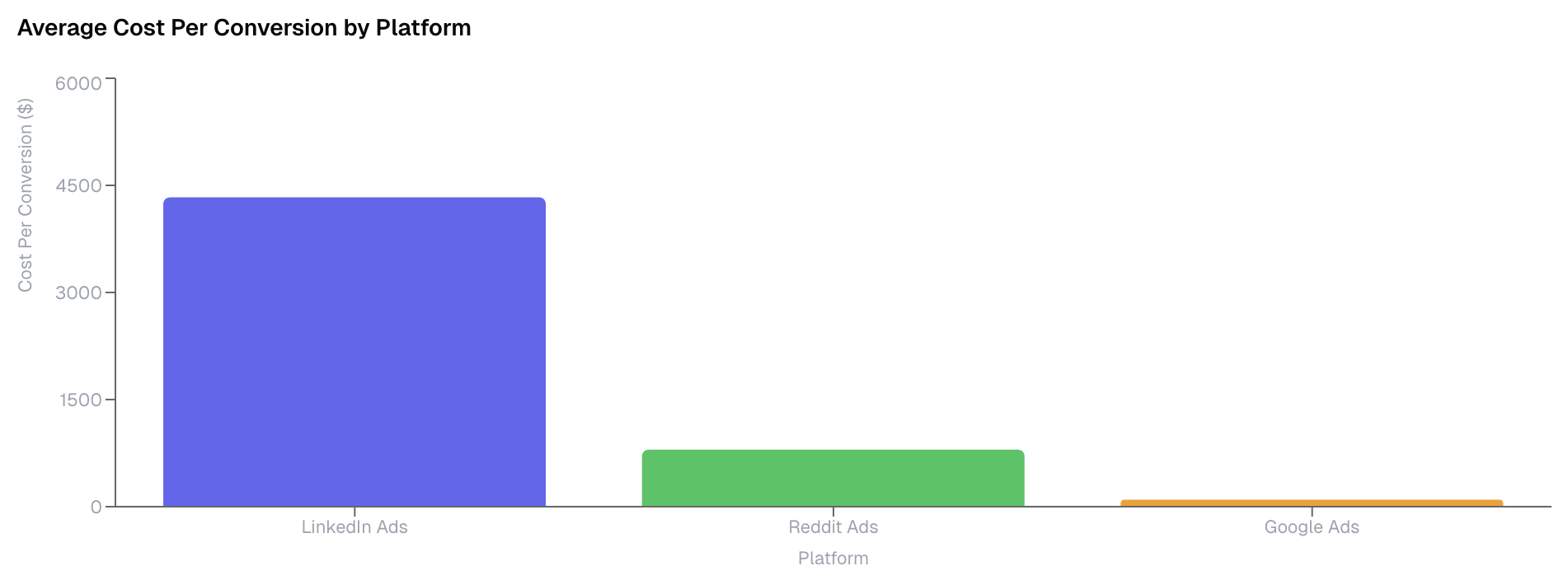
| Platform | Avg Cost Per Conversion | Success Rate | Best Use Case |
|---|---|---|---|
| Google Ads | $97 | 60% | High-intent search traffic |
| LinkedIn Ads | $4,333 | 0% | None — avoid entirely |
| Reddit (Paid) | $800 | 0% | None — use organic instead |
| Reddit (Organic) | $0 | 80% | Community building |
Why These Differences Exist
The performance gap between these platforms isn't random — it's structural. Each platform attracts users in a fundamentally different mindset, and that mindset determines whether your ad dollars turn into customers or vanish into the void.
Google Ads: Intent-Driven Performance
Google's advantage is that it captures demand that already exists. Someone searching “best CRM for small agencies” has already identified their problem and is actively evaluating solutions. You're not convincing them they have a problem — you're showing up at the moment they're ready to solve it. This is why Google delivers 2–3% conversion rates while Meta struggles at 0.3–0.5%. The intent gap is enormous.
But Google punishes laziness. The founders who fail almost always share the same mistakes: they send traffic to their homepage instead of a dedicated landing page, they target broad keywords without building negative keyword lists, and they don't give campaigns enough budget or time to optimize. Google's algorithm needs data to learn, and $500/month isn't enough to generate statistically meaningful results.
What Works:
- Users actively searching for solutions
- 2–3% conversion rates vs Meta's 0.3–0.5%
- Performance Max achieving 8–12x ROAS when optimized
What Fails:
- Poor landing page quality (major budget killer)
- Broad targeting without negative keywords
- Insufficient budget for testing ($1,000+ minimum needed)
LinkedIn Ads: Platform Mismatch
LinkedIn's failure isn't about the audience — the right people are genuinely on the platform. The problem is how those people behave on LinkedIn. They're scrolling between meetings, engaging with thought leadership posts, and building their professional network. They're not evaluating software purchases. When a B2B ad appears in their feed, it registers the same way a billboard does on a highway: vaguely noticed, immediately forgotten.
LinkedIn's cost structure makes this behavioral mismatch fatal. At $18+ per click, you need an extraordinarily high conversion rate to make the math work. But the people clicking are often the wrong audience entirely — junior employees, students, and researchers who are curious but have no purchasing authority. The platform's targeting can put your ad in front of the right job title, but it can't make that person ready to buy.
Why It Fails:
- Users trained to ignore promotional content
- Extremely high cost structure ($18+ per click)
- Lead quality issues (students vs decision makers)
- Platform optimized for engagement, not conversions
Reddit: Community vs Commerce
Reddit is a platform built on authenticity and community trust. Its users have finely tuned BS detectors and will call out promotional content instantly. This is why paid ads fail — they feel foreign to the platform experience. But it's also why organic engagement works so well. When a founder earns trust by genuinely helping people in a subreddit over weeks and months, their eventual product recommendation carries the weight of a peer endorsement, not an advertisement.
The 70/30 rule that successful Reddit founders follow — 70% genuine value, 30% product mention — works because it mirrors how real community members behave. You're not pretending to be helpful to sell something. You're being helpful, and occasionally your product is part of that help. The community can tell the difference, and they reward the real thing with engagement, upvotes, and ultimately purchases.
Why Paid Fails:
- Users actively resist traditional advertising
- “Fat-finger” clicks with zero intent
- Community-driven platform rejects promotional content
Why Organic Works:
- 70% value, 30% product mention ratio
- Building reputation before promoting
- Authentic participation over months
The Final Verdict for B2B Startups
Winner: Google Ads (with Major Caveats)
Google Ads is the only platform showing consistent positive ROI when properly executed. However, success requires:
- Minimum $2,000+ monthly budget for meaningful testing
- Dedicated landing pages matched to keywords
- Aggressive negative keyword management
- Continuous optimization every few days
Runner-up: Organic Reddit (for Specific Verticals)
If your target audience is active on Reddit, organic community engagement delivers exceptional results at zero cost. However, it requires:
- 3–6 months of consistent participation before promotion
- Deep understanding of community norms
- Genuine value contribution before any product mentions
Avoid: LinkedIn Ads
Zero successful case studies in our database. The platform's cost structure and user behavior make it unsuitable for B2B startup budgets.
Recommendations by Startup Stage
Pre-PMF (under $10K MRR):
- Skip all paid ads
- Focus on organic Reddit if audience matches
- Use direct sales outreach instead
Early Growth ($10K–$50K MRR):
- Test Google Ads with $2,000+ monthly budget
- Continue organic strategies
- Avoid LinkedIn and Reddit paid entirely
Scale Stage ($50K+ MRR):
- Scale Google Ads with proper attribution
- Test multi-platform approach (Google + organic)
- Still avoid LinkedIn ads
The data is clear: for B2B startups, Google Ads offers the best chance of positive ROI, but only with proper execution and sufficient budget. LinkedIn burns money, and Reddit works best organically. Choose your channels based on data, not platform marketing promises.
This analysis is based on real case studies from Wovly's database of GTM experiments. Individual results may vary based on industry, product, and execution quality.
Keep reading


Ready to make better strategic decisions?
See how Wovly helps teams turn tough business problems into structured experiments.
Get Started